
Life has been a whirlwind of travel, learning, and both new and old projects. March came in like a lion, leaving a very heavy snow followed by strong winds. Many of our trees, including Anne’s spring canary sign, the ornamental cherries, were damaged and some of the climbing roses were pushed out of the trees and structures and tossed to the ground or in nearby trees.
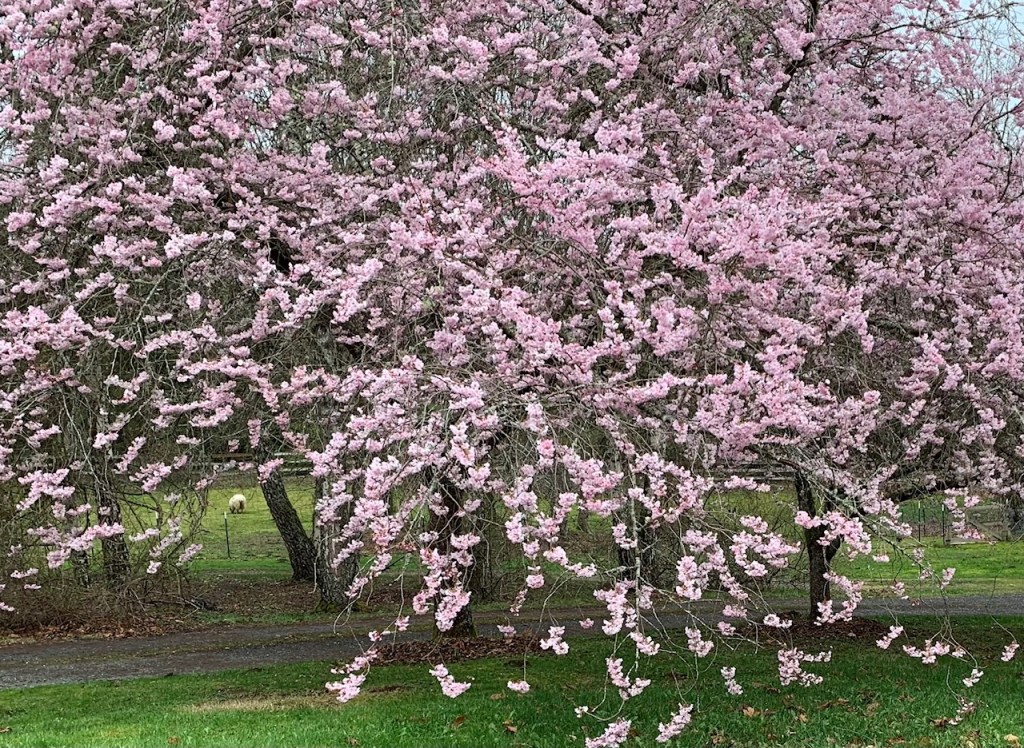
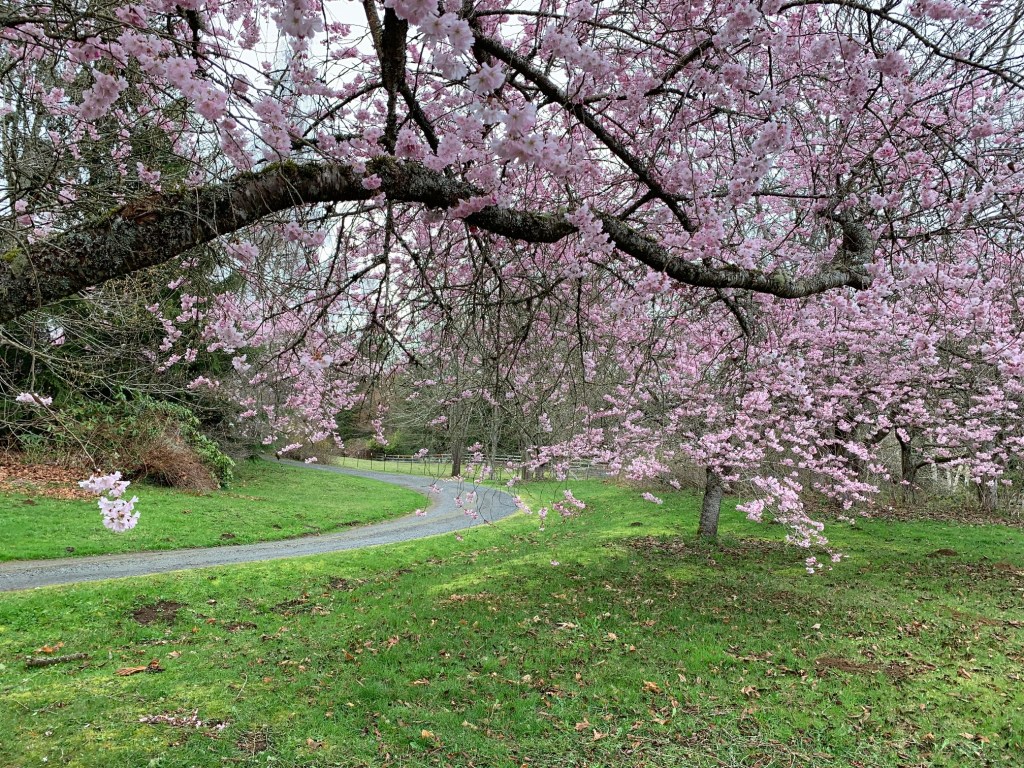
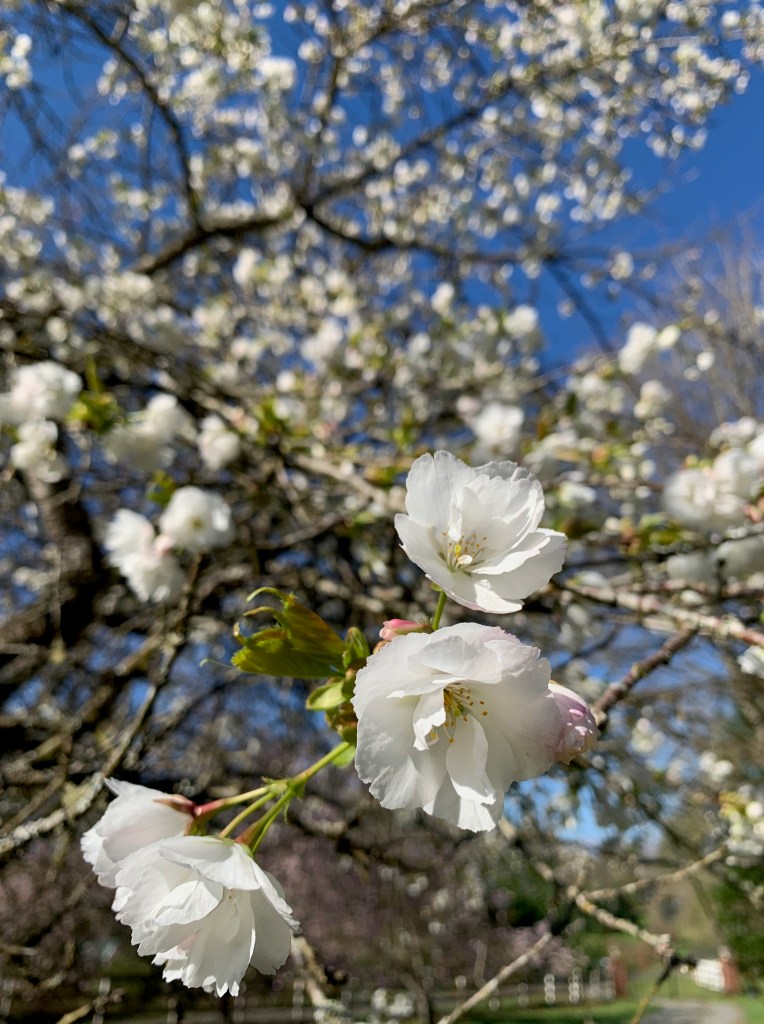
Not to worry though. The old roses are tough. Only one lost it’s base (hopefully not its root system) under a tree and I hope to see a new cane or two breaking through the soil soon. This is a reminder of Anne’s legacy project and why it’s important. We need to get the older roses in people’s back yards, nurseries, and public and private gardens. When there are only a few roses of a particular variety, it is easy to loose them forever.
During the month of February I was back in Indiana for the science teachers conference drumming up enthusiasm for the projects I am still working on there – the Indiana Envirothon, a natural resources competition for high school students, and The Hoosier Science Teacher, and publication of The Hoosier Science Teachers, Inc. (HASTI) that I edit and could always use more reviewers and submissions. (By the way, if you are a science teacher or a scientist, please consider writing and submitting a manuscript.) In addition, I took what was left of the time to continue cleaning out the pole barn which still contains items from my prior move from Louisville. And then I was off to Florida with my mother and father. They are snowbirds – Michiganders who go to Florida in the winter. It is always and adventure to be with them. I loved every minute.
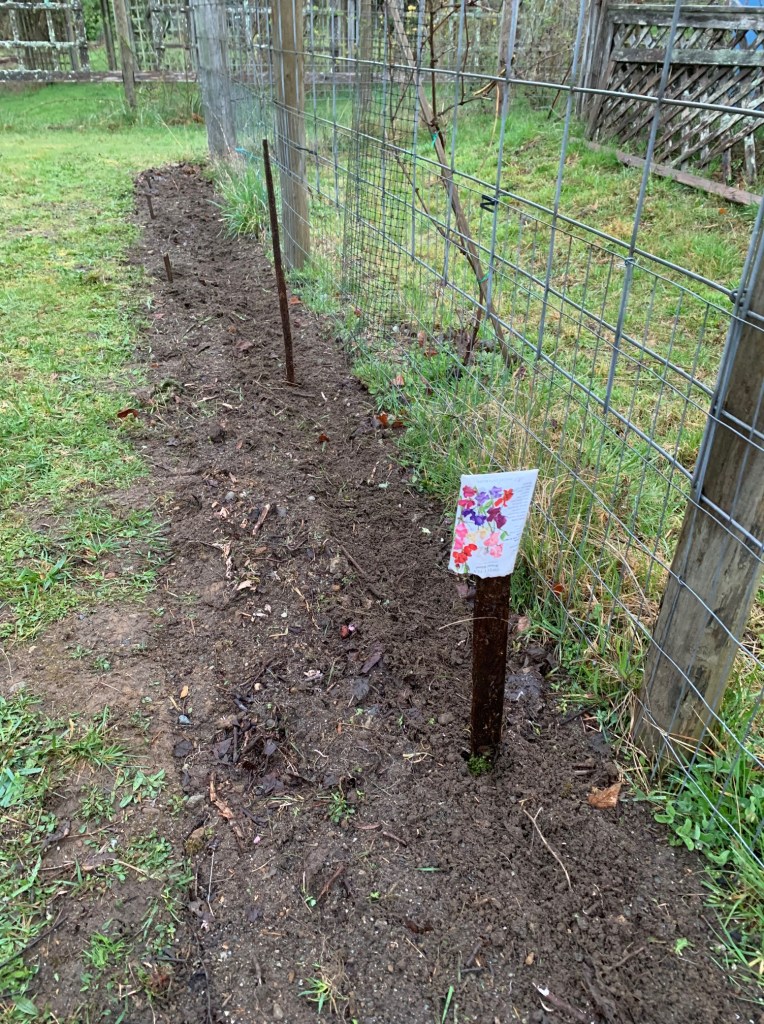
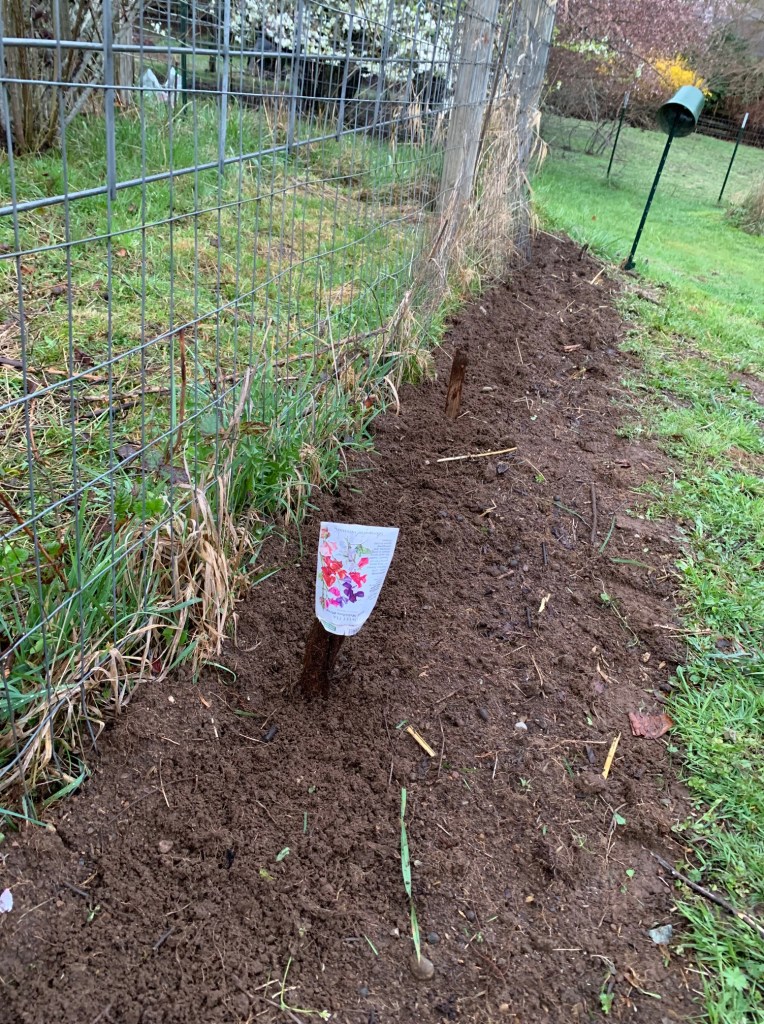
While in Florida, I kept thinking about how far behind I must be in gardening projects. How would I ever catch up with the rose pruning and surely I was too late with the sweet peas. OK, I might have been a little late with the snow peas, but not the rest. Our cold temperatures broke a couple of weeks ago. We might have one more bout of early morning freezing temperatures around out last average freeze date of April 15th. But, we’re good. The roses are leafing out beautifully and our front fence is lined with the 100 flowers from the bulbs I planted last fall. I’m pruning, cleaning up the trees, and preparing for the coming season.
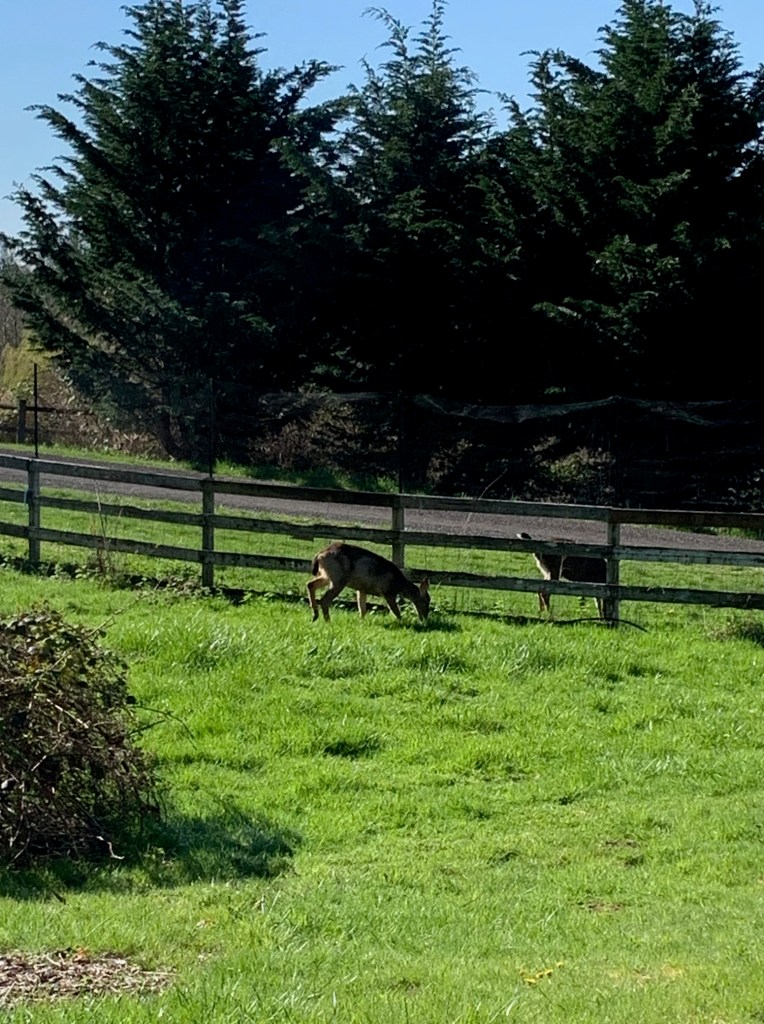
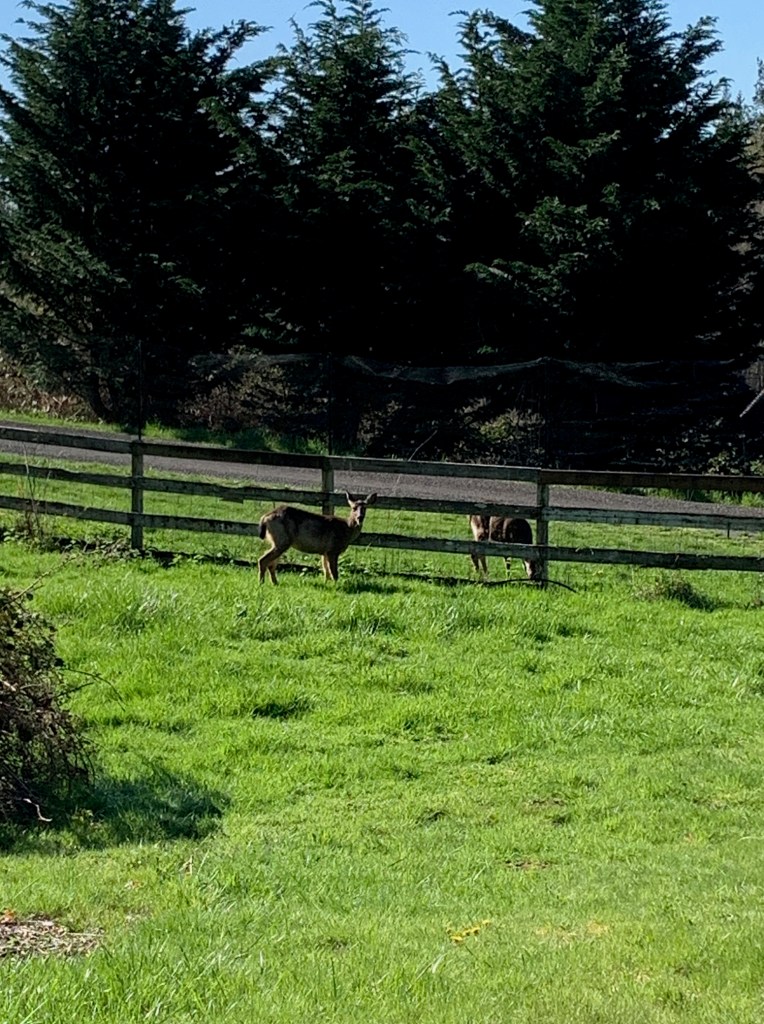
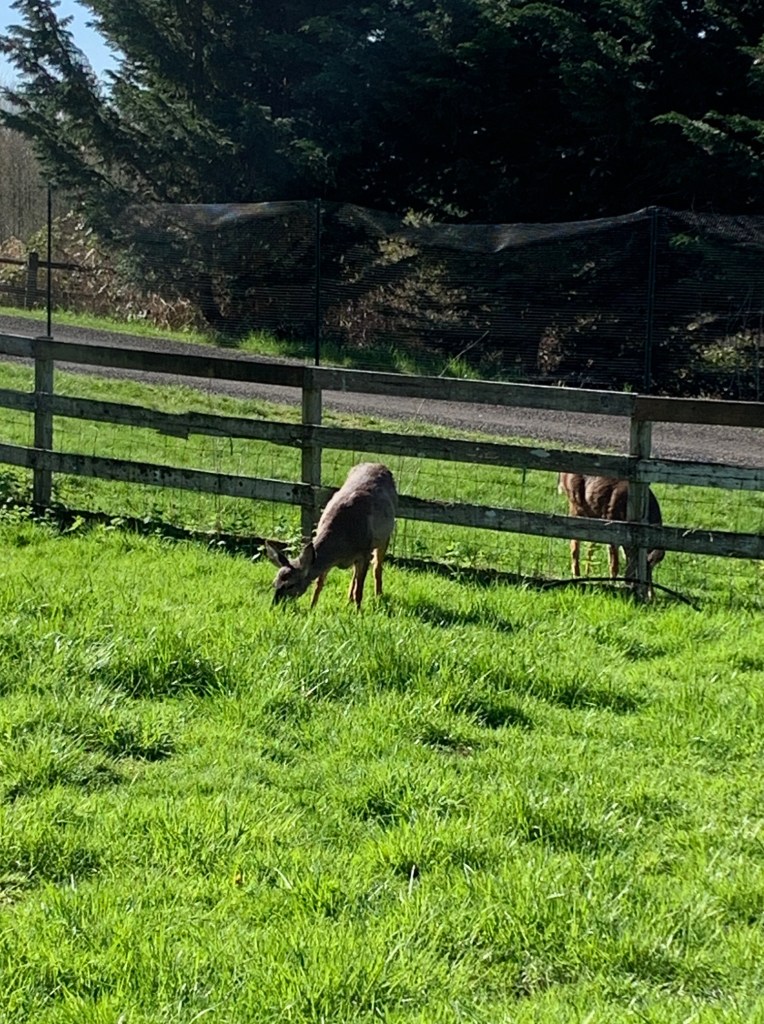
Oh, and also repairing the deer fence.
For the past couple of days I’ve been working on the roses in the driveway and east side sidewalk. These are Alexandre Girault, Crepescule, Pierre de Ronsard, Bonny, maybe Elina (still trying to revive this jewel), Kathryn Morley, Clair Renaissance, and Yellow Charles Austin along with an overgrown Polish Spirit clematis which has woven its way through all of these roses. Early ambition led me to schedule two days for this work. After three days I’m seeing results but I am not even close to being done.
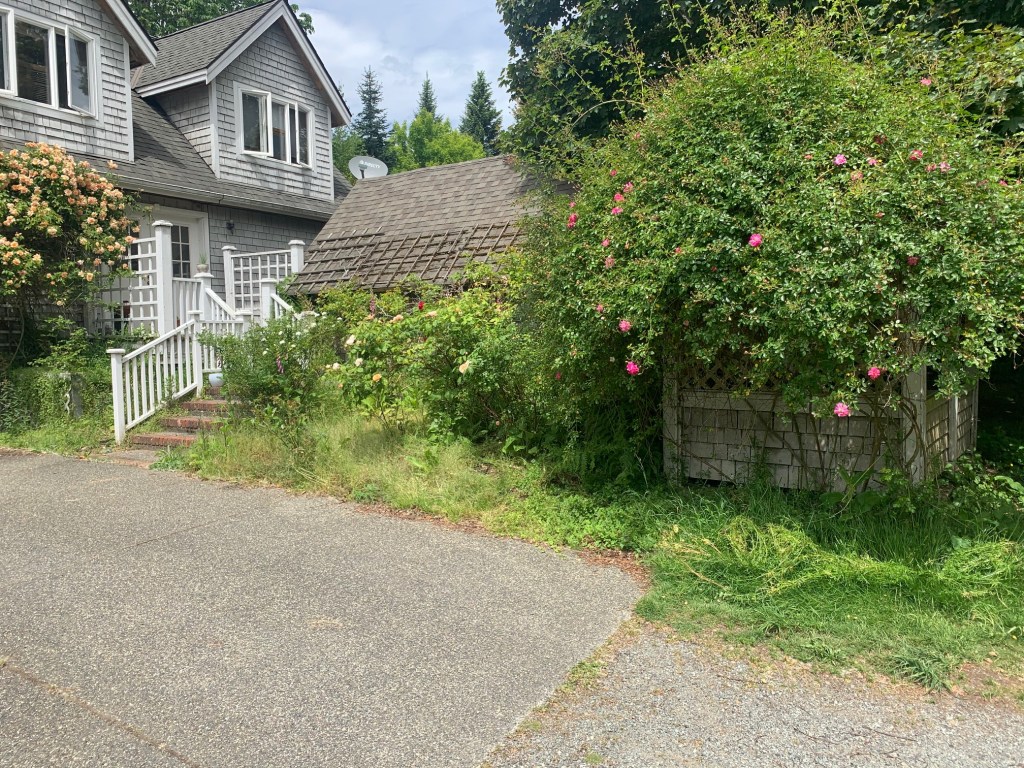
I have now been working on Alexandre Girault for three years. Why, you might ask? Beginner’s reservation. It is a magnificent rose and this one, at least on the outer visible side was lush and an exceptionally large spectacle – something you would see on a magazine cover about cottage gardens. However, it was taking out the propane shed. I was worried that I would lose this rose if I started cutting it back too much. Thank goodness for members of the Heritage Rose Northwest and a few Facebook friends who gave me the confidence to be much more aggressive in pruning. Last year, I finally cut out ALL of the deadwood – even that which seemed to hold up the few newer canes, cut back some of the laterals, and started training sessions for the canes that were flopping down into the driveway. The bloom was impressive and I was rewarded with several new canes. This week, I feel so much better about what I am doing and am being even a little more aggressive. I carefully relaxed the ties on the canes in order to paint the propane shed it covers. Next I cut out dead and/or damaged canes and then retied them so they go where I want them to. I was able to get the longer canes up and over the roof and very loosely tie them in place. It is a much thinner plant than it was three years ago, yet it is really healthy looking. We will know if I can call it a win in June.
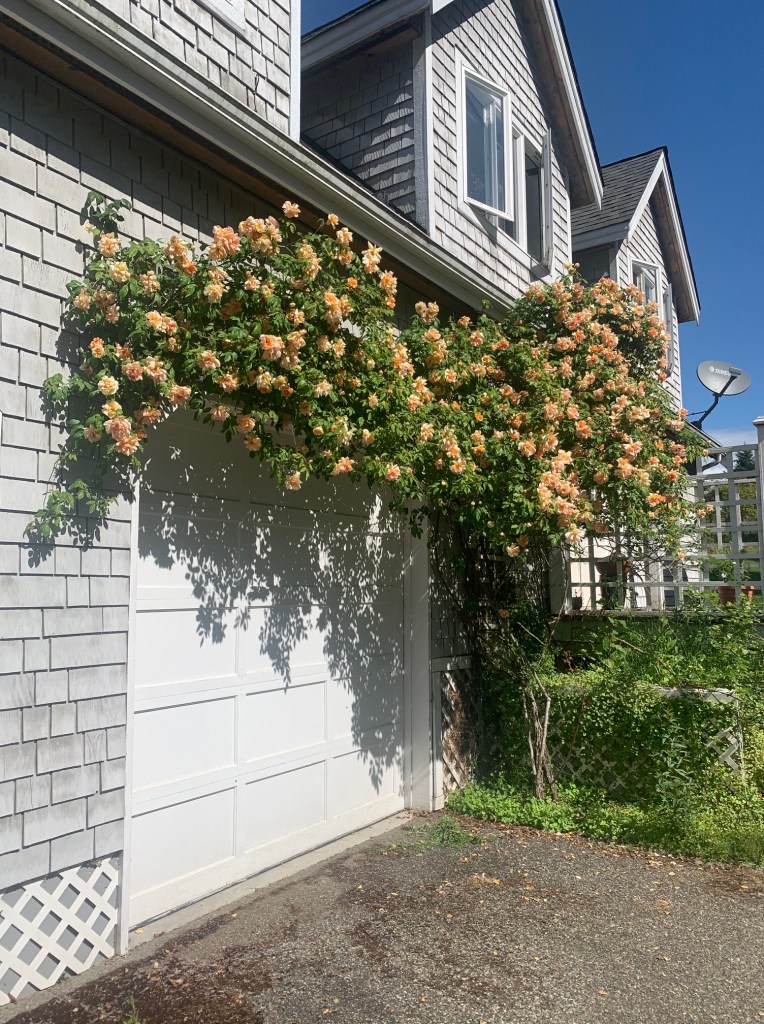
Crepescule was also very full and gorgeous the first year I was here. I think it was at its peak of what a rose can do if let go. I could blame it on the two really cold winters we had, but it was more than die back. Last year I took out the dead and damaged wood and cut back the canes that were going under gutters, cedar shingle siding, and other places they shouldn’t be. What was left was a very diminished plant that couldn’t reach up and over the garage door as it had before. Cutting the lead cane always gives me pause, but just as we know will happen when you cut just above the “eye” a lateral will grow to be the lead. This year, the canes are long enough to stretch up to an over the trellis above the garage door and are now secured for what is hopefully a good bloom season.
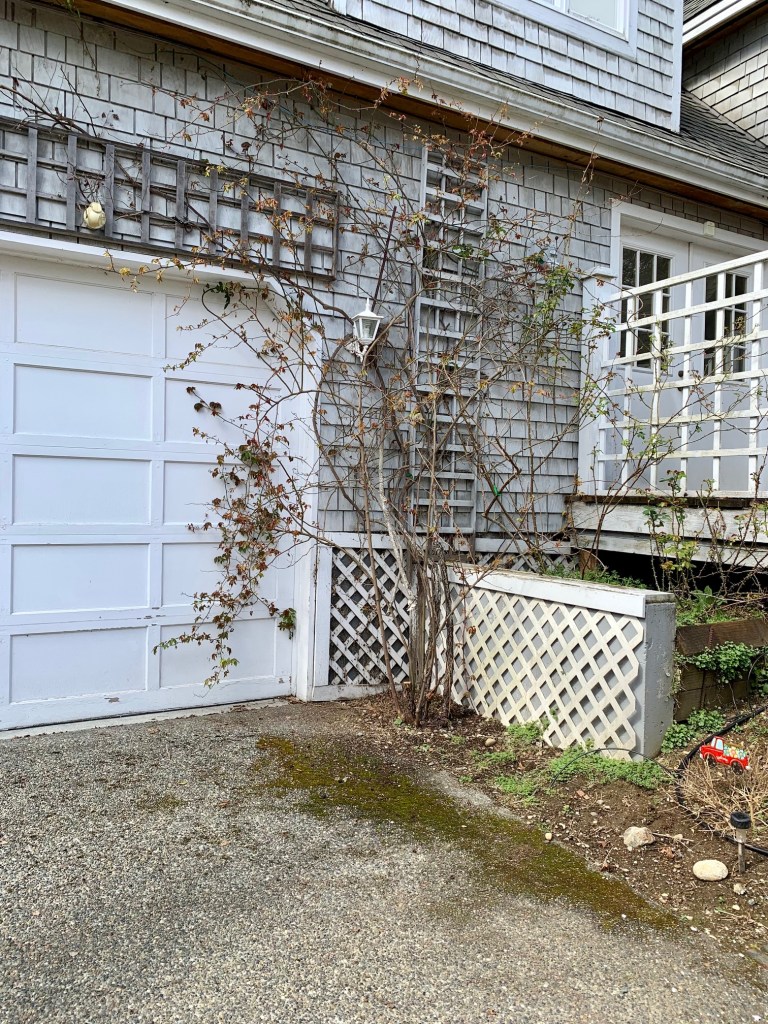
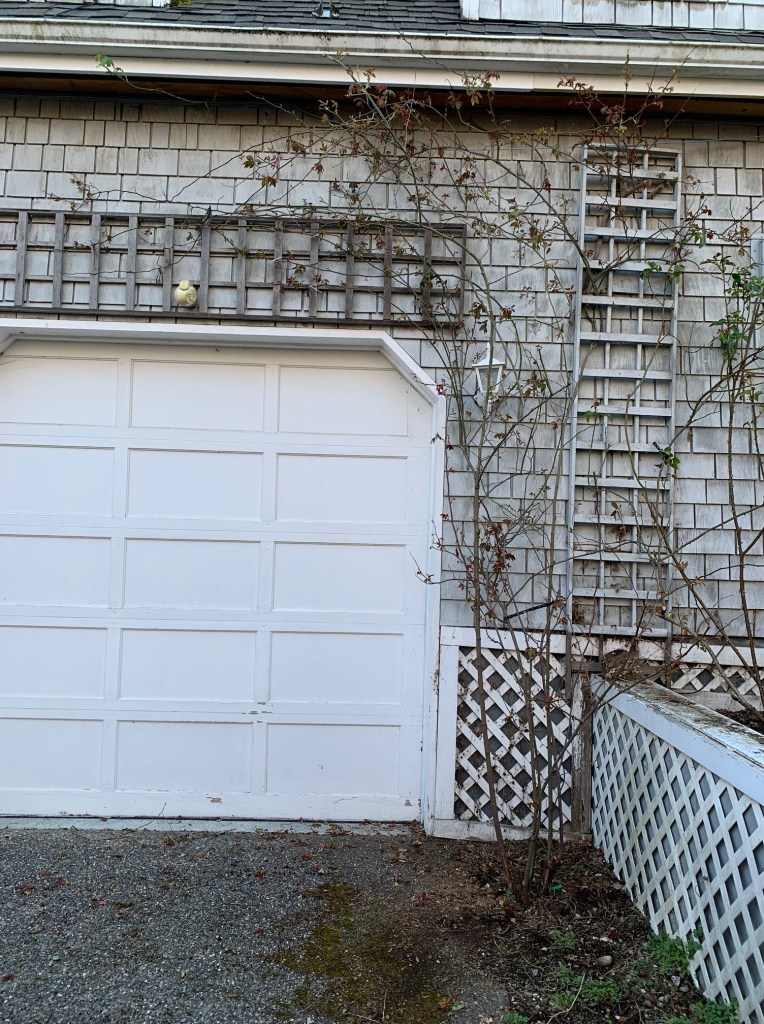
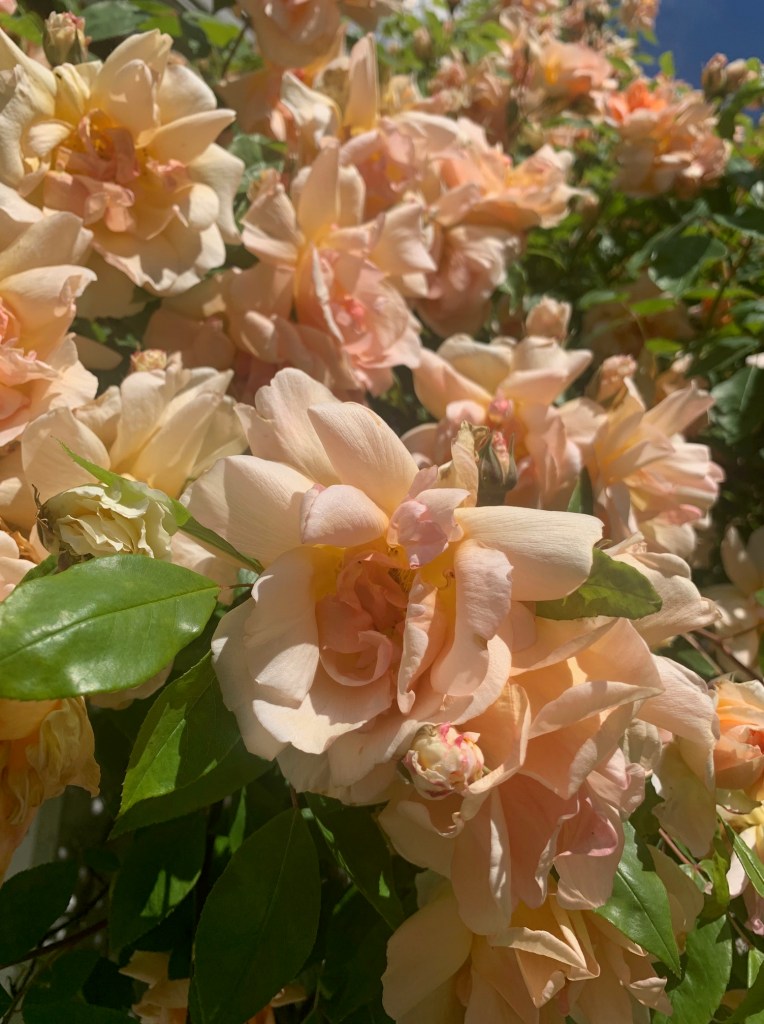
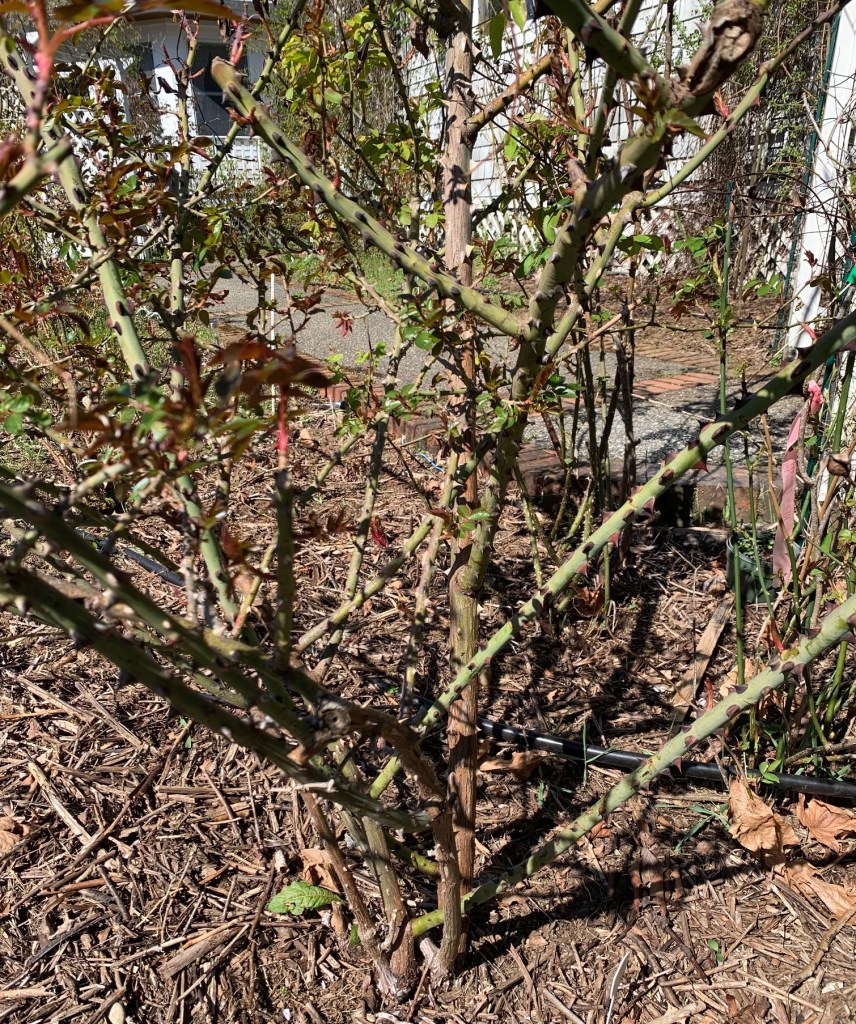
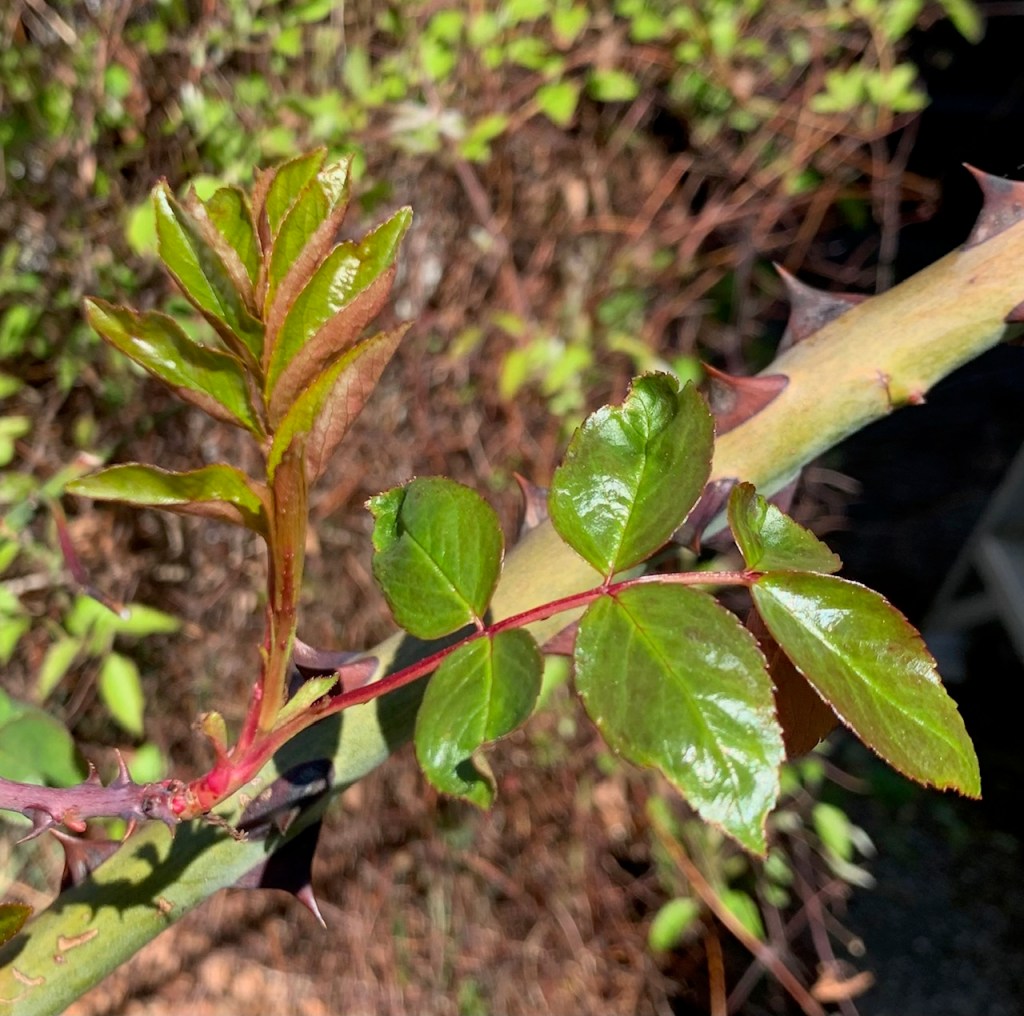
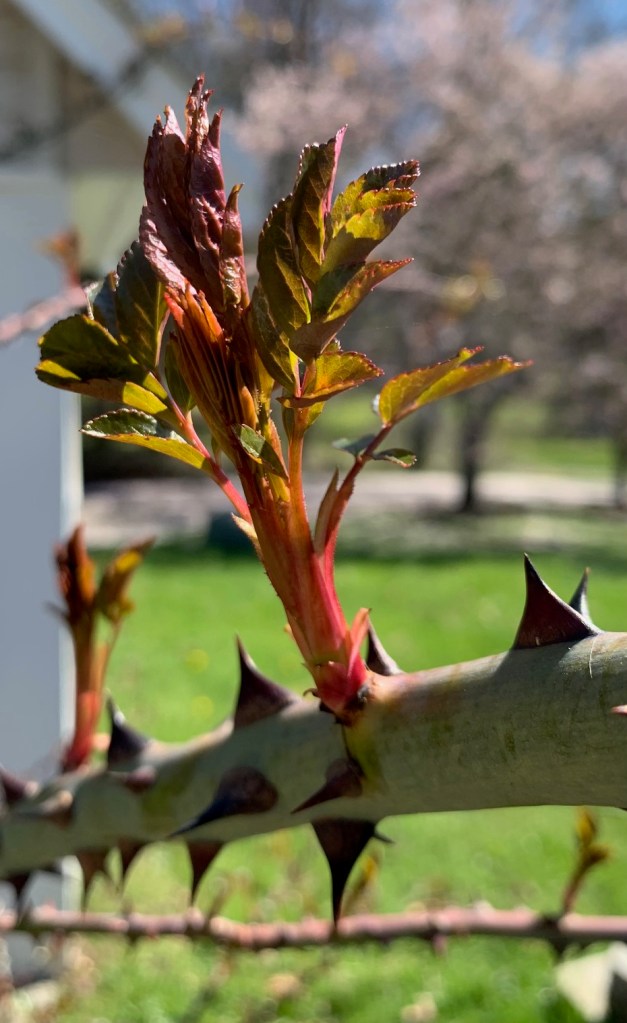
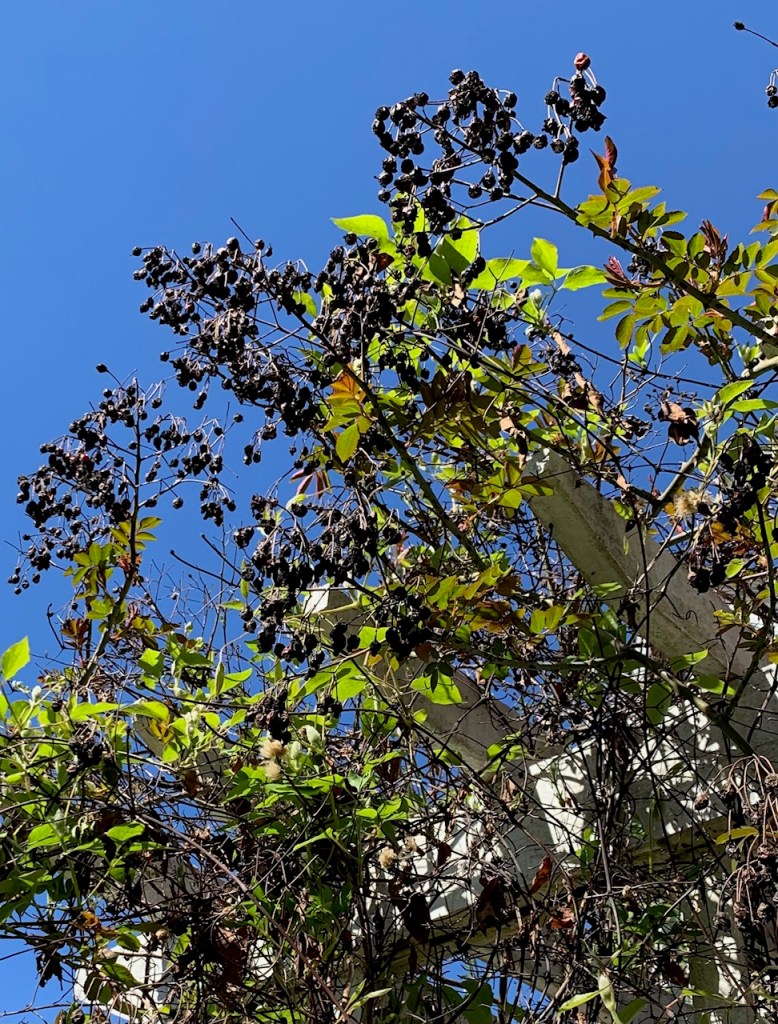
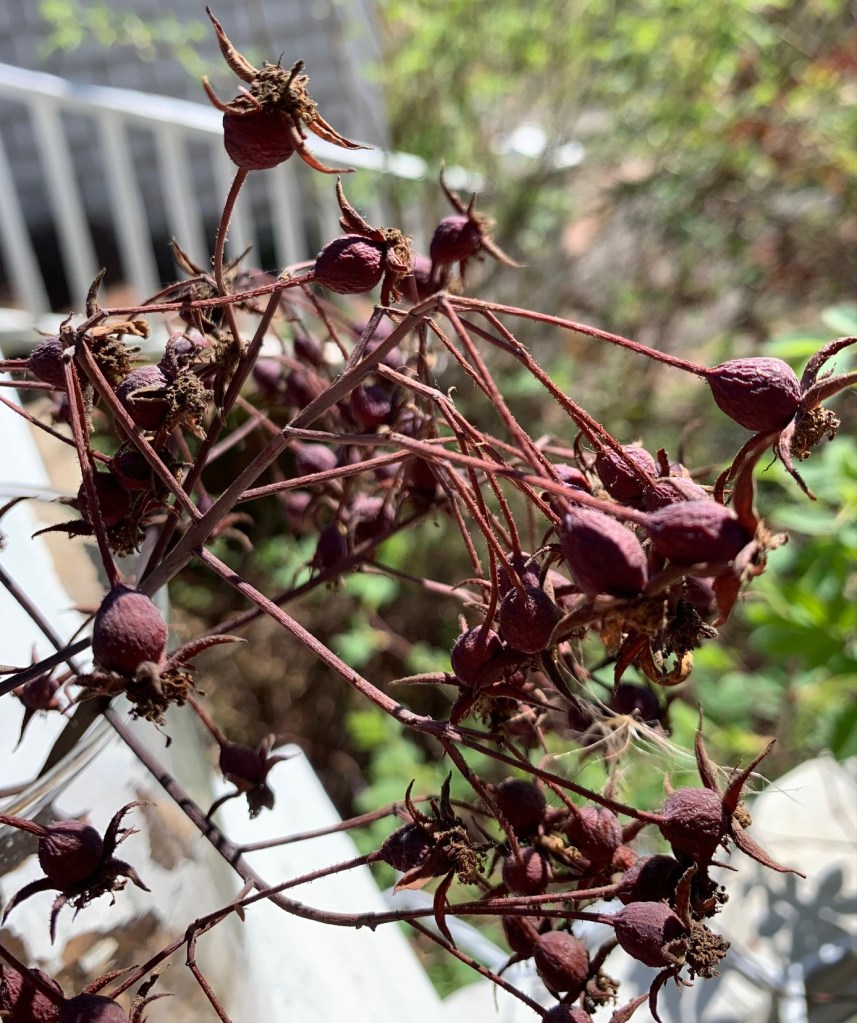
I am still working on the others listed above. The Yellow Charles Austin is done and spread out wonderfully on the trellis just below and to the side of the second story window over the garage. ‘Polish Spirit’ has been cut back to so the roses in the area can share the trellis. However before I can do much more, my attention needs to be on the rose on the other side of the sidewalk arbor. I have threatened, many times especially when I get caught up in its thorns. I cut it back to a short bush once, thinking I could manage it better until I could figure out what it is. However, I swear it grew canes that were at least 10 feet over night. (Maybe a little exaggeration.) Now it has canes that are approximately 18 feet and growing. In Anne’s notes, she mentions 14 species roses were planted. I’m wondering if this is one of them. At first, it wouldn’t seem that she would put a large species plant so close to the house. It could also be a comeback root stock, but not of the kind we typically use here in the US. It has been suggested that it could be a Rose longicuspis var. sinowilsonii. If any of you have ideas, please let me know. It is a vigorous grower with long arching canes (up to 20 ft that I have seen so far) that become thick and heavy. Black strong upright thorns – approximately 1/2 inch in height, that go the gray with age. Small white flowers are many and clustered. Hips are small and green and turn to a deep purple. (They dry well and look good in floral arrangements.) A few pictures from today are included and although I took pictures of this rose last year, I can’t fine them now. As this unknown rose goes through its life cycle, I’ll add pictures so we can arrive at a conclusion of what it is.
Some of you have asked for an update on our garden events for this year. There have been many changes in our schedule (weddings, graduations, family reunions, the Indiana farm, etc.) for 2024 which has made it difficult to schedule garden events. Things are coming together though, so while later than expected I should have something up by April 15th.
Here is a peak into some of cool things in the planner to celebrate Anne Belovich’s 100 birthyear:
- A exciting announcement about the Save the Ramblers project will be made on April 26th at the American Rose Center in Shreveport, LA. Our family is so grateful to Claude Graves and the team that is making this happen!
- I’ll be sharing Anne’s Gardens and legacy with the Dallas Rose Society via Zoom on May 28th. If the spinosissimas are in bloom we will take a short virtual tour of them as a special bonus.
- I’ll be sharing information about Anne’s Gardens and our Indiana/Michigan rose project at the Indianapolis Rose Society on July 9th. If all goes well, I’ll bring cuttings too.
- Heritage Rose NW Rose Society will meet here for their July meeting. If you live in the area and grow or want to grow heirloom roses, consider joining the HRNW. The members have been a great help to me, sharing their expertise and stories. If you don’t live in this area, consider joining the heritage rose or rose society in your area.
- We will be working in the garden through out the season and have a couple of open garden days in June and/or July.
I still have a couple of daylight hours and I’m getting antsy to get back outside, so I will close. It’s a beautiful day and I hope to work in the Lavender Garden yet today. In addition to the lavender, the Penzance roses are there: Jeannie Deans (pre-1892, hybrid rubiginosa), Julia Mannering (1895, hybrid rubiginosa), Anne of Geierstien (1894, hybrid rubiginosa, eglantine, sweet brier), Edith Bellenden (1895, hybrid rubiginosa), and Greenmantle (1895, Rosa rubiginosa x Rosa foetida). The namesake roses Lord Penzance and Lady Penzance have not been found yet. Also in that bed are the Virginian Rambler (origin unknown, hybrid arvensis – ayrshire per ARS) and Manning’s Blush (Manning, pre-1797, hybrid rubiginosa).
Wishing you the best of days in your own garden.
 Anne Belovich's Roses of Yesteryear
I think about Max and Anne often. Max invited me to the rose garden around 2003. I was a tech at Skagit hospital. He saw my sadness going through a divorce. At the time I actually lived on Rose Rd. Near their home. They both made an impact in my soul. We sat on the porch of their little house in the back. Wine and cheese and crackers. Sylvia
LikeLike
What a sweet memory, Sylvia. Rick and I are so moved by the stories of the many people they touched. We had no idea of the support and fond thoughts people remember. Max and Anne were generous spirits. Both went through many hardships and because of this were supportive and dedicated to supporting those who were going through difficult times. The cabin is gone now. It’s been donated to The Pioneer Village down the street. If you were referring to the pavilion in the back of the formal rose garden, it’s still there. The flooring was hazardous, but when we removed it we found the joists were still sturdy. We are now in the process of removing the old planks and putting down new ones. If you are still in the area, please feel free to stop by. You can also take a cutting or two of roses to start in your own backyard. Or, just a bouquet if you prefer.
Thank you for your story.
Teddie
LikeLike
I’ll be avidly following the development of your unknown species rose. I don’t THINK it’s sinowilsonii, the one i’ve been after, but let’s hope it is. Sinowilsonii is distinctive in it’s huge foliage,(the largest of any rose), with mahogany brown backs, and it’s reddish mahogany stems. Please keep posing pics as it develops. The black thorns do look familiar though, from some pic i’ve seen, somewhere…
LikeLiked by 1 person